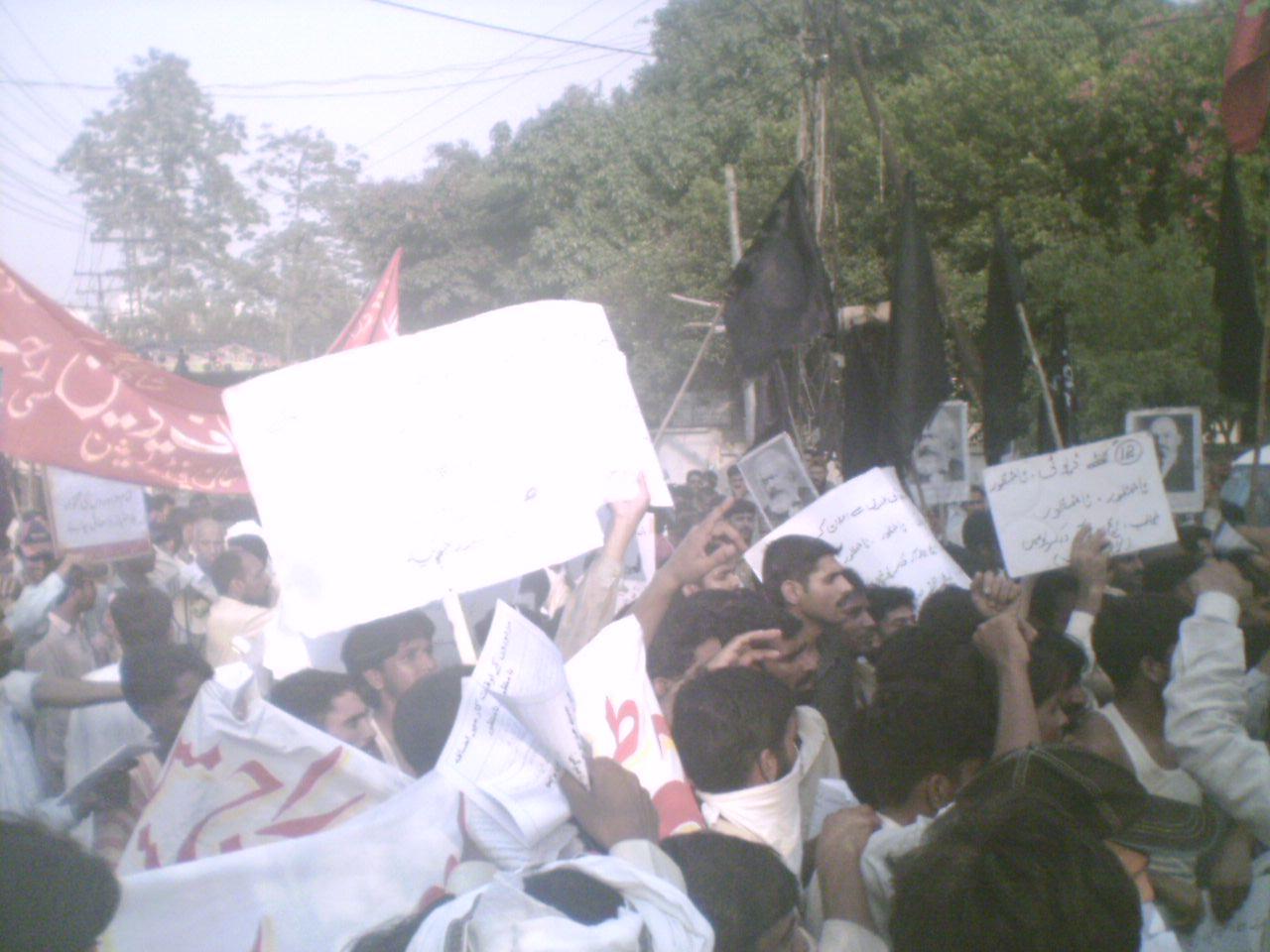
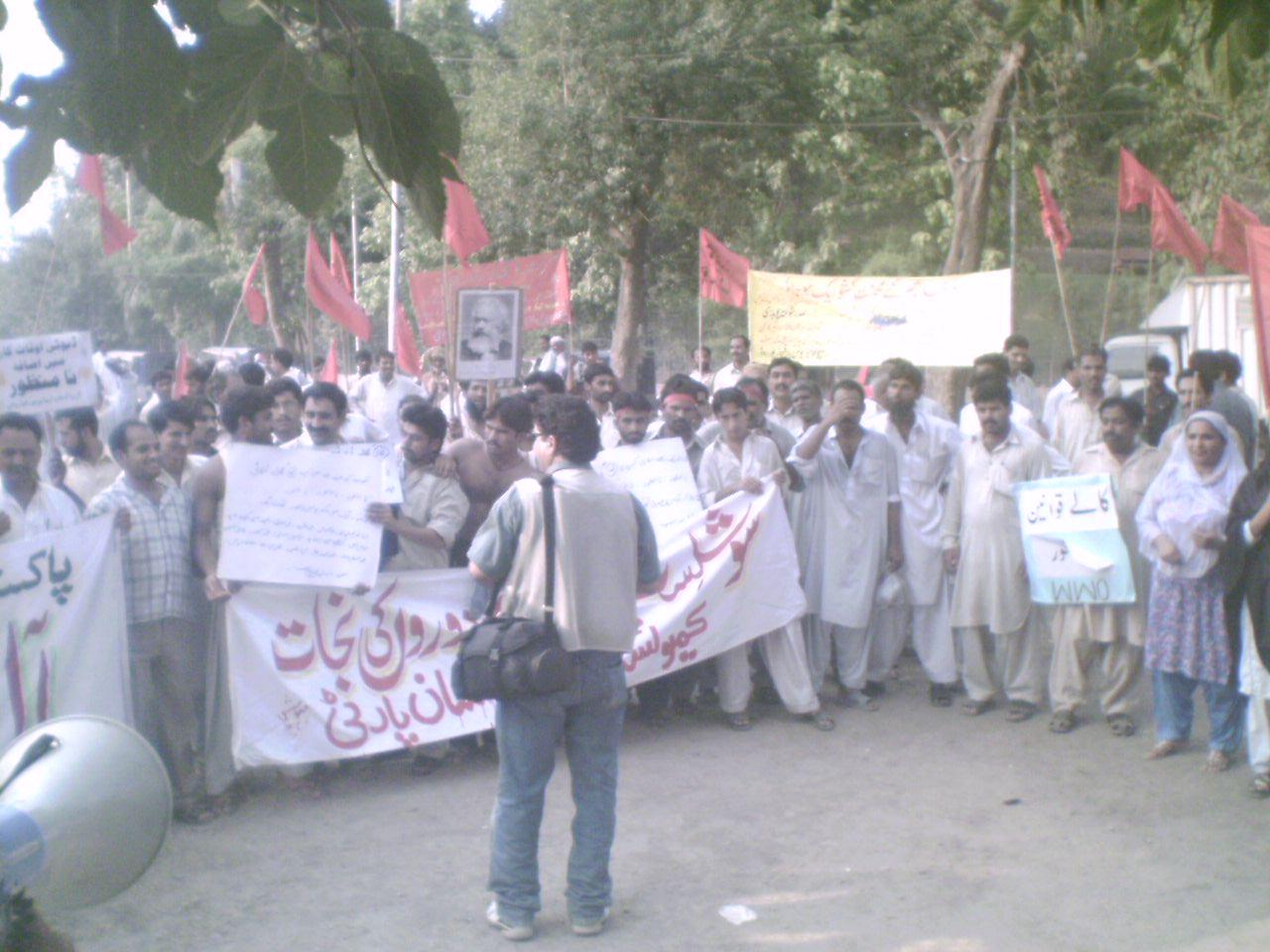
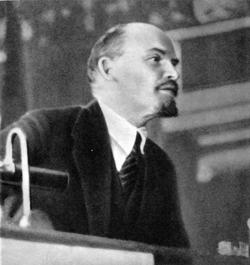
[This post includes a group of messages written by my comrade- Bhagat Singh-during the course of an open polemics.]
You have reverted into the tradition of Trotskyism. The tradition of slandering and fabrication. You said:
Lenin says in his article “On the slogan of a United states of Europe”:
”Uneven economic and political development is an absolute law of capitalism. Hence, the victory of socialism is possible first in several or even in one capitalist country alone.”
[Progress Publishers volume 21 , p 339-343]
The dictatorship of the proletariat is the class alliance between the proletariat and the labouring masses of the peasantry for the purpose of overthrowing capital, for achieving the final victory of socialism, on the condition that the guiding force of this alliance is the proletariat.
The theory of permanent revolution is not a question of "slightly" underestimating or "slightly" overestimating the revolutionary potentialities of the peasant movement, as certain diplomatic advocates of "permanent revolution" are now fond of expressing it. It is a question of the nature of the new proletarian state which arose as a result of the October Revolution. It is a question of the character of the proletarian power, of the foundations of the dictatorship of the proletariat itself.
page 123
"The dictatorship of the proletariat," says Lenin, "is a special form of class alliance between the proletariat, the vanguard of the working people, and the numerous non-proletarian strata of working people (the petty bourgeoisie, the small proprietors, the peasantry, the intelligentsia, etc.), or the majority of these; it is an alliance against capital, an alliance aiming at the complete overthrow of capital, at the complete suppression of the resistance of the bourgeoisie and of any attempt on its part at restoration, an alliance aiming at the final establishment and consolidation of socialism." (See Vol. XXIV, p. 311.)
And further on:
"The dictatorship of the proletariat, if we translate this Latin, scientific, historical-philosophical term into simpler language, means the following:
"Only a definite class, namely, the urban workers and the factory, industrial workers in general, is able to lead the whole mass of the toilers and exploited in the struggle for the overthrow of the yoke of capital, in the process of the overthrow itself, in the struggle to maintain and consolidate the victory, in the work of creating the new, socialist social system, in the whole struggle for the complete abolition of classes." (See Vol. XXIV, p. 336.)
Such is the theory of the dictatorship of the proletariat given by Lenin.
Lenin constantly reiterated that without an alliance with these masses of other nationalities the proletariat of Russia could not achieve victory. In his articles on the national question and in his speeches at the congresses of the Comintern, Lenin repeatedly said that the victory of the world revolution was impossible without a revolutionary alliance, a revolutionary bloc, between the proletariat of the advanced countries and the oppressed peoples of the enslaved colonies. But what are colonies if not the oppressed labouring masses, and, primarily, the labouring masses of the peasantry? Who does not know that the question of the liberation of the colonies is essentially a question of the liberation of the labouring masses of the non-proletarian classes from the oppression and exploitation of finance capital?
But from this it follows that Lenin's theory of the dictatorship of the proletariat is not a purely "Russian" theory, but a theory which necessarily applies to all countries. Bolshevism is not only a Russian phenomenon. "Bolshevism," says Lenin, is "a model of tactics for all." (See Vol. XXIII, p. 386 )
Such are the characteristics of the first specific feature of the October Revolution.
How do matters stand with regard to Trotsky's theory of "permanent revolution" in the light of this specific feature of the October Revolution?
We shall not dwell at length on Trotsky's position when he "simply" forgot all about the peasantry as a revolutionary force and advanced the slogan of "No tsar, but a workers' government," that is, the slogan of revolution without the peasantry. Even Radek, that diplomatic defender of "permanent revolution," is now obliged to admit that "permanent
revolution" in 1905 meant a "leap into the air" away from reality. Now, apparently everyone admits that it is not worth while bothering with this "leap into the air" any more.
Nor shall we dwell at length on Trotsky's position in the period of the war, say, in 1915, when, in his article "The Struggle for Power," proceeding from the fact that "we are living in the era of imperialism," that imperialism "sets up not the bourgeois nation in opposition to the old regime, but the proletariat in opposition to the bourgeois nation," he arrived at the conclusion that the revolutionary role of the peasantry was bound to subside, that the slogan of the confiscation of the land no longer had the same importance as formerly. It is well known that at that time, Lenin, examining this article of Trotsky's, accused him of "denying" "the role of the peasantry," and said that "Trotsky is in fact helping the liberal labour politicians in Russia who understand 'denial' of the role of the peasantry to mean refusal to rouse the peasants to revolution!" (See Vol. XVIII, p. 318.)
Let us rather pass on to the later works of Trotsky on this subject, to the works of the period when the proletarian dictatorship had already become established and when Trotsky had had the opportunity to test his theory of "permanent revolution" in the light of actual events and to correct his errors. Let us take Trotsky's "Preface" to his book The Year 1905, written in 1922. Here is what Trotsky says in this "Preface" concerning "permanent revolution":
"It was precisely during the interval between January 9 and the October strike of 1905 that the views on the character of the revolutionary development of Russia which came to be known as the theory of 'permanent revolution' crystallized in the author's mind. This abstruse term represented the revolution, whose immediate objectives were bourgeois in nature, could not, however, stop when these objectives had been achieved. The revolution would not be able to solve its immediate bourgeois problems except by placing the proletariat in power. And the latter, upon assuming power, would not be able to confine itself to the bourgeois limits of the revolution. On the contrary, precisely in order to ensure its victory, the proletarian vanguard would be forced in the very early stages of its rule to make deep inroads not only into feudal property but into bourgeois property as well. In this it would come into hostile collision not only with all the bourgeois groupings which supported the proletariat during the first stages of its revolutionary struggle, but also with the broad masses of the peasantry with whose assistance it came into power. The contradictions in the position of a workers' government in a backward country with an overwhelmingly peasant population could be solved only on an international scale, in the arena of the world proletarian revolution."
That is what Trotsky says about his "permanent revolution."
One need only compare this quotation with the above quotations from Lenin's works on the dictatorship of the proletariat to perceive the great chasm that separates Lenin's theory of the dictatorship of the proletariat from Trotsky's theory of "permanent revolution."
Lenin speaks of the alliance between the proletariat and the labouring strata of the peasantry as the basis of the dictatorship of the proletariat. Trotsky sees a "hostile collision " between "the proletarian vanguard" and "the broad masses of the peasantry."
Lenin speaks of the leadership of the toiling and exploited masses by the proletariat. Trotsky sees "contradictions in the position of a workers' government in a backward country with an overwhelmingly peasant population."
According to Lenin, the revolution draws its strength primarily from among the workers and peasants of Russia itself.
According to Trotsky, the necessary strength can be found only "in the arena of the world proletarian revolution."
But what if the world revolution is fated to arrive with some delay? Is there any ray of hope for our revolution? Trotsky offers no ray of hope; for "the contradictions in the position of a workers' government . . . could be solved only . . . in the arena of the world proletarian revolution." According to this plan, there is but one prospect left for our revolution: to vegetate in its own contradictions and rot away while waiting for the world revolution.
What is the dictatorship of the proletariat according to Lenin?
The dictatorship of the proletariat is a power which rests on an alliance between the proletariat and the labouring masses of the peasantry for "the complete overthrow of capital" and for "the final establishment and consolidation of socialism."
What is the dictatorship of the proletariat according to Trotsky?
The dictatorship of the proletariat is a power which comes "into hostile collision" with "the broad masses of the peas antry" and seeks the solution of its "contradictions" only "in the arena of the world proletarian revolution."
What difference is there between this "theory of permanent revolution" and the well-known theory of Menshevism which repudiates the concept of dictatorship of the proletariat?
Essentially, there is no difference.
There can be no doubt at all. "Permanent revolution" is not a mere underestimation of the revolutionary potentialities of the peasant movement. "Permanent revolution" is an underestimation of the peasant movement which leads to the repudiation of Lenin's theory of the dictatorship of the proletariat.
Trotsky's "permanent revolution" is a variety of Menshevism.
This is how matters stand with regard to the first specific feature of the October Revolution.
What are the characteristics of the second specific feature of the October Revolution?
In his study of imperialism, especially in the period of the war, Lenin arrived at the law of the uneven, spasmodic, economic and political development of the capitalist countries. According to this law, the development of enterprises, trusts, branches of industry and individual countries proceeds not evenly -- not according to an established sequence, not in such a way that one trust, one branch of industry or one country is always in advance of the others, while other trusts or countries keep consistently one behind the other -- but spasmodically, with interruptions in the development of some countries and leaps ahead in the development of others. Under these circumstances the "quite legitimate" striving of the countries that have slowed down to hold their old positions, and the equally "legitimate" striving of the countries that have leapt ahead to seize new positions, lead to a situation in which armed clashes among the imperialist countries become an inescapable neces sity. Such was the case, for example, with Germany, which half a century ago was a backward country in comparison with France and Britain. The same must be said of Japan as compared with Russia. It is well known, however, that by the beginning of the twentieth century Germany and Japan had leapt so far ahead that Germany had succeeded in overtaking France and had bcgun to press Britain hard on the world market, while Japan was pressing Russia. As is well known, it was from these contradictions that the recent imperialist war arose.
his law proceeds from the following:
1) "Capitalism has grown into a world system of colonial oppression and of the financial strangulation of the vast ma jority of the population of the world by a handful of 'advanced' countries" (see Preface to the French edition ot Lenin's Imperialism, Vol. XIX, p. 74);
2) "This 'booty' is shared between two or three powerful world robbers armed to the teeth (America, Britain, Japan), who involve the whole world in their war over the sharing of their booty" (ibid.);
3) The growth of contradictions within the world system of financial oppression and the inevitability of armed clashes lead to the world front of imperialism becoming easily vulnerable to revolution, and to a breach in this front in individual coun tries becoming probable;
4) This breach is most likely to occur at those points, and in those countries, where the chain of the imperialist front is weakest, that is to say, where imperialism is least consolidated, and where it is easiest for a revolution to expand;
5) In view of this, the victory of socialism in one country, even if that country is less developed in the capitalist sense, while capitalism remains in other countries, even if those countries are more highly developed in the capitalist sense -- is quite possible and probable.
Such, briefly, are the foundations of Lenin's theory of the proletarian revolution.
What is the second specific feature of the October Revolution? The second specific feature of the October Revolution lies in the fact that this revolution represents a model of the practical application of Lenin's theory of the proletarian revolution.
He who has not understood this specific feature of the October Revolution will never understand either the international nature of this revolution, or its colossal international might, or the specific features of its foreign policy.
"Uneven economic and political development," says Lenin, "is an absolute law of capitalism. Hence, the victory of socialism is possible first in several or even in one capitalist country taken separately. The victorious proletariat of that country, having expropriated the capitalists and organized its own socialist production, would stand up against the rest of the world, the capitalist world, attracting to its cause the oppressed classes of other countries, raising revolts in those countries against the capitalists, and in the event of necessity coming out even with armed force against the exploiting classes and their states." For "the free union of nations in socialism is impossible without a more or less prolonged and stubborn struggle of the socialist republics against the backward states." (See Vol. XVIII, pp. 232-33.)
The opportunists of all countries assert that the proletarian revolution can begin -- if it is to begin anywhere at all, according to their theory -- only in industrially developed countries, and that the more highly developed these countries are industrially the more chances there are for the victory of socialism. Moreover, according to them, the possibility of the victory of socialism in one country, and one in which capitalism is little developed at that, is excluded as something absolutely im probable. As far back as the period of the war, Lenin, taking as his basis the law of the uneven development of the imperialist states, opposed to the opportunists his theory of the proletarian revolution about the victory of socialism in one country, even if that country is one in which capitalism is less developed.
It is well known that the October Revolution fully confirmed the correctness of Lenin's theory of the proletarian revolution.
How do matters stand with Trotsky's "permanent revolution" in the light of Lenin's theory of the victory of the proletarian revolution in one country?
Let us take Trotsky's pamphlet Our Revolution (1906).
Trotsky writes:
"Without direct state support from the European proletariat, the working class of Russia will not be able to maintain itself in power and to transform its temporary rule into a lasting socialist dictatorship. This we cannot doubt for an instant."
What does this quotation mean? It means that the victory of socialism in one country, in this case Russia, is impossible "without direct state support from the European proletariat," i.e., before the European proletariat has conquered power.
What is there in common between this "theory" and Lenin's thesis on the possibility of the victory of socialism "in one capitalist country taken separately"? Clearly, there is nothing in common.
But let us assume that Trotsky's pamphlet, which was published in 1906, at a time when it was difficult to determine the character of our revolution, contains inadvertent errors and does not fully correspond to Trotsky's views at a later period. Let us examine another pamphlet written by Trotsky, his Peace Programme, which appeared before the October Revolution of 1917 and has now (1924) been republished in his book The Year 1917. In this pamphlet Trotsky criticizes Lenin's theory of the proletarian revolution about the victory of socialism in one country and opposes to it the slogan of a United States of Europe. He asserts that the victory of socialism in one country is impossible, that the victory of socialism is possible only as the victory of several of the principal countries of Europe (Britain, Russia, Germany), which combine into a United States of Europe; otherwise it is not possible at all. He says quite plainly that "a victorious revolution in Russia or in Britain is inconceivable without a revolution in Germany, and vice versa."
"The only more or less concrete historical argument," says Trotsky, "advanced against the slogan of a United States of Europe was formulated in the Swiss Sotsial-Demokrat (at that time the central organ of the Bolsheviks -- J. St. ) in the following sentence: 'Uneven economic and political development is an absolute law of capitalism.' From this the Sotsial-Demokrat draws the conclusion that the victory of socialism is possible in one country, and that therefore there is no reason to make the dictatorship of the proletariat in each separate country contingent upon the establishment of a United States of Europe. That capitalist development in different countries is uneven is an absolutely incontrovertible argument. But this unevenness is itself extremely uneven. The capitalist level of Britain, Austria, Germany or France is not identical. But in comparison with Africa and Asia all these countries represent capitalist 'Europe,' which has grown ripe for the social revolution. That no country in its struggle must 'wait' for others, is an elementary thought which it is useful and necessary to reiterate in order that the idea of concurrent international action may not be replaced by the idea of temporizing international inaction. Without waiting for the others, we begin and continue the struggle nationally, in the full confidence that our initiative will give an impetus to the struggle in other countries; but if this should not occur, it would be hopeless to think -- as historical experience and theoretical considerations testify -- that, for example, a revolutionary Russia could hold out in the face of a conservative Europe, or that a socialist Germany could exist in isolation in a capitalist world."
As you see, we have before us the same theory of the simultaneous victory of socialism in the principal countries of Europe which, as a rule, excludes Lenin's theory of revolution about the victory of socialism in one country.
Carried away by his criticism of Lenin's theory of the proletarian revolution, Trotsky unwittingly dealt himself a smashing blow in his pamphlet Peace Programme which appeared in 1917 and was republished in 1924.
But perhaps this pamphlet, too, has become out of date and has ceased for some reason or other to correspond to Trotsky's present views? Let us take his later works, written after the victory of the proletarian revolution in one country, in Russia. Let us take, for example, Trotsky's "Postscript," written in 1922, for the new edition of his pamphlet Peace Programme. Here is what he says in this "Postscript":
"The assertion reiterated several times in the Peace Programme that a proletarian revolution cannot culminate victoriously within national bounds may perhaps seem to some readers to have been refuted by the nearly five years' experience of our Soviet Republic. But such a conclusion would be unwarranted, The fact that the workers' state has held out against the whole world in one country, and a backward country at that, testifies to the colossal might of the proletariat, which in other, more advanced, more civilized countries will be truly capable of performing miracles. But while we have held our ground as a state politically and militarily, we have not arrived, or even begun to arrive, at the creation of a socialist society. . . . As long as the bourgeoisie remains in power in the other European countries we shall be compelled, in our struggle against economic isolation, to strive for agreements with the capitalist world; at the same time it may be said with certainty that these agreements may at best help us to mitigate some of our economic ills, to take one or another step forward, but real progress of a socialist economy in Russia will become possible only after the victory[*] of the proletariat in the major European countries." Thus speaks Trotsky, plainly sinning against reality and stubbornly trying to save his "permanent revolution" from final shipwreck.
It appears, then, that, twist and turn as you like, we not only have "not arrived," but we have "not even begun to arrive" at the creation of a socialist society. It appears that some people have been hoping for "agreements with the capitalist world," but it also appears that nothing will come of these agreements; for, twist and turn as you like, "real progress of a socialist economy" will not be possible until the proletariat has been victorious in the "major European countries."
Well, then, since there is still no victory in the West, the only "choice" that remains for the revolution in Russia is: either to rot away or to degenerate into a bourgeois state.
It is no accident that Trotsky has been talking for two years now about the "degeneration" of our Party.
It is no accident that last year Trotsky prophesied the "doom" of our country.
How can this strange "theory" be reconciled with Lenin's theory of the "victory of socialism in one country"?
How can this strange "prospect" be reconciled with Lenin's view that the New Economic Policy will enable us "to build the foundations of socialist economy"?
How can this "permanent" hopelessness be reconciled, for instance, with the following words of Lenin: "Socialism is no longer a matter of the distant future, or an abstract picture, or an icon. We still retain our old bad opinion of icons. We have dragged socialism into everyday life, and here we must find our way. This is the task of our day, the task of our epoch. Permit me to conclude by expressing the conviction that, difficult as this task may be, new as it may be compared with our previous task, and no matter how many difficulties it may entail, we shall all -- not in one day, but in the course of several years -- all of us together fulfil it whatever happens so that NEP Russia will become socialist Russia." (See Vol. XXVII, p. 366.)
How can this "permanent" gloominess of Trotsky's be reconciled, for instance, with the following words of Lenin:
"As a matter of fact, state power over all large-scale means of production, state power in the hands of the proletariat, the alliance of this proletariat with the many millions of small and very small peasants, the assured leadership of the peasantry by the proletariat, etc. -- is not this all that is necessary for building a complete socialist society from the co-operatives, from the co-operatives alone, which we formerly looked down upon as huckstering and which from a certain aspect we have the right to look down upon as such now, under NEP? Is this not all that is necessary for building a complete socialist society? This is not yet the building of socialist society, but it is all that is necessary and sufficient for this building." (See Vol. XXVII, p 392.)[2]
It is plain that these two views are incompatible and cannot in any way be reconciled. Trotsky's "permanent revolution" is the repudiation of Lenin's theory of the proletarian revolution; and conversely, Lenin's theory of the proletarian revolution is the repudiation of the theory of "permanent revolution."
From the masterpiece "On the Opposition" written by none other than the greatest Marxist-Leninist of our epoch: Joseph Stalin. The man who DESTROYED the ideological roots of the decadent theory of Trotskyism
Long Live Marxism-Leninism!
Long Live Stalin!
Long Live Mao Tse Tung!
Long Live Ho Chi Minh!
Long Live Che Guevara!
Long Live Kim Il Sung!
Long Live the victory of Socialism!
Death to revisionism!
Death to Trotskyism
Bhagat Singh can be reached at bhagatlives@gmail.com